⏱️ Your First 60 Minutes
- Harvest wood and stone with your rock — hit the sweet spots for bonus yield
- Collect cloth from hemp plants for a sleeping bag
- Eat berries, pumpkins, or corn before your hunger empties
- Craft a stone hatchet, stone pickaxe, and hammer
- Place a sleeping bag to set your respawn point
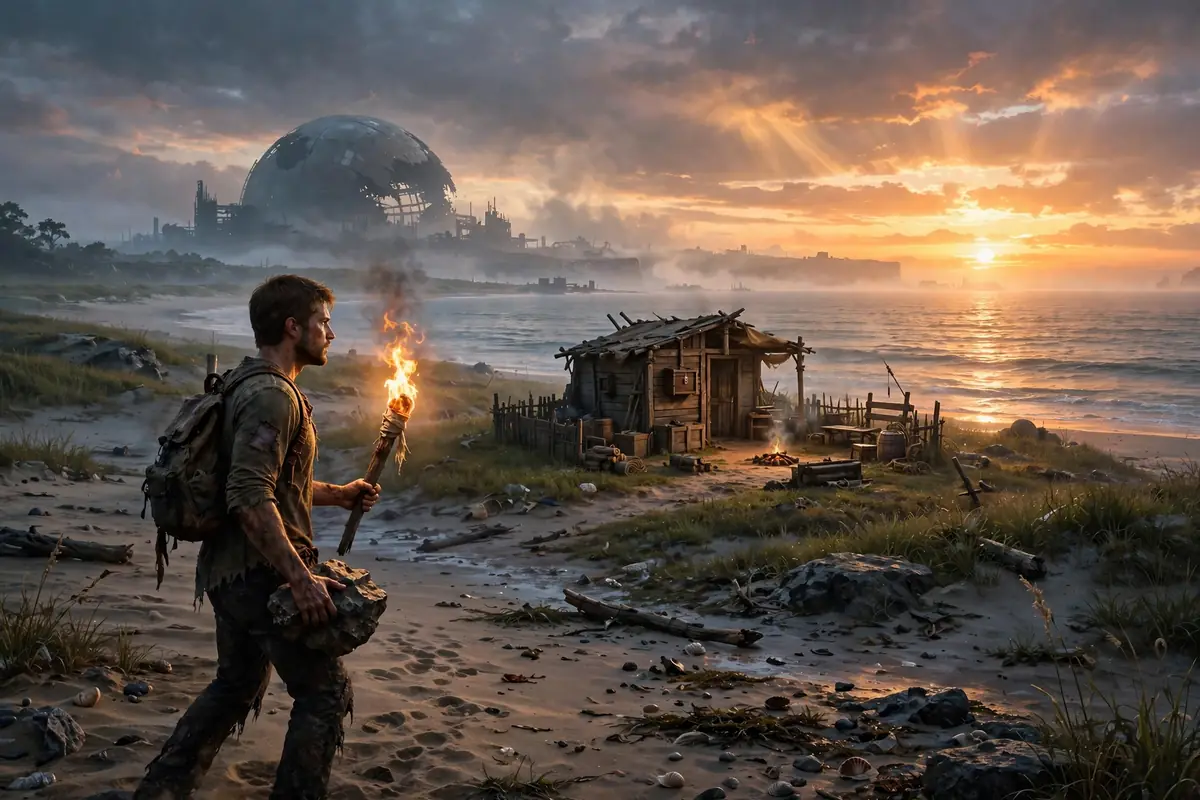
Rust has no tutorial, no safe zone outside two small monuments, and absolutely no mercy. You spawn naked on a beach with a rock and a torch, and within minutes someone with a rifle may be deciding whether you’re worth the bullet. Most new players die within their first hour — not in glorious raids, but to hunger, thirst, a bad base location, and the oldest Rust tradition of all: trusting a stranger.
This guide fixes that. It covers exactly what to do in your first minutes, how building and upkeep actually work, where the loot is (and where the death is), and the seven mistakes that kill almost every beginner. Follow it and you’ll survive your first wipe. Then the real game begins.
What Rust Is in 2026
Rust is a multiplayer survival game by Facepunch where dozens of players share one procedurally generated island. You gather, build, craft, and fight — and everything you build can be destroyed by other players. The island wipes on a regular schedule, so progress is temporary and every wipe is a fresh start.
The game is still actively developed. Facepunch ships a named update every month alongside the forced wipe: recent 2026 updates include the Shipshape naval update (modular boats, deep-sea zones, floating cities), a Built Different player-model overhaul with a new M16A2 rifle, the Common Ground update (a new Apartment Complex monument, rentable shops, and a clan system), and September’s Livestock Update — a farming refresh with cows, sheep, breeding, and a Biofuel Generator that turns organic matter into fuel.
Before You Start: Pick the Right Server
Rust has two kinds of servers: official (run by Facepunch, vanilla settings, highest population, toughest for beginners) and community (admin-set schedules, common variants like 2x–5x gather rates, no-blueprint-wipe, and solo/duo/trio limits).
For your first 20–30 hours, find a low-population community server — ideally one labelled beginner or noob-friendly — using BattleMetrics, the standard third-party server tracker. Check the wipe schedule before you commit: official servers wipe on the first Thursday of every month (forced wipe, tied to the monthly update), and most community servers follow the same rhythm or wipe weekly/biweekly. Starting 12 hours before a wipe is a waste of your time.
Your First 10 Minutes: Rock, Torch, Survive
You spawn at a random point on a shore — always a beach, never inland — naked, with a rock in your first hotbar slot and a torch. Your vitals start low: roughly 60 of 100 health, 40 of 500 hunger, 50 of 250 thirst. Those bars drain constantly. Food and water are survival priority number one.
Do this, in order:
1. Harvest wood and stone. Hit trees and boulders with your rock. Watch for the sweet spots — trees show a red X, boulders a sparkle — hitting them yields noticeably more per hit.
2. Collect cloth. Hemp plants give roughly 10 cloth each; animals give cloth too. You need cloth for a sleeping bag.
3. Eat something. Berry bushes, pumpkins, and corn grow wild. Eat before your hunger empties.
Don’t wander. Don’t fight anyone. A naked with a rock loses every fight that matters. Your only job in the first minutes is resources.
First Tools: Hatchet, Pickaxe, Hammer
Craft a Stone Hatchet (200 wood + 100 stone, for wood) and a Stone Pickaxe (200 wood + 100 stone, for stone, metal ore, sulfur ore, and HQM ore). Both are default blueprints — you know them from the start, no research needed.
Next, craft a Hammer. It rotates structures, upgrades them through the tiers, and repairs damage. One critical rule: you cannot upgrade or repair a structure for 30 seconds after it takes damage, so don’t expect to patch walls mid-raid.
Cloth to Sleeping Bag: Your First Respawn Point
A sleeping bag costs 30 cloth and 30 seconds to craft. Place it on the ground and it becomes your personal respawn point. When you die, you can choose to respawn at a placed bag or bed — otherwise you’re back at a random beach.
Place several bags in different spots (bags can be renamed and assigned to friends). If your main base gets raided while you’re offline, a hidden backup bag somewhere in the wilderness is the difference between rebuilding and restarting.
Your First Base: The 2×2 With an Airlock
Use the Building Plan (default blueprint) to place twig foundations. The standard starter base is a 2×2: two-by-two foundations of enclosed core, plus a triangle foundation at the entrance forming an airlock — two doors in series.
The airlock is the single most important beginner building concept. If you die with your outer door open, or a raider slips in behind you, they still face a second locked door before your loot. No airlock means one mistake costs you everything.
Build order wisdom:
1. Place the Tool Cupboard first (see below) and authorize yourself.
2. Upgrade the core to stone (75–300 stone per block) — stone is the baseline that forces raiders to use explosives. Wood burns.
3. Add honeycomb later: extra layers of triangle and square walls around the core, so raiders must blow through multiple walls to reach your loot.
4. Upgrade doors to sheet metal (150 metal frags) and use code locks, not key locks — a key looted off your corpse opens everything, but a code can’t be stolen.
The Tool Cupboard: Place It Before Anything Else
The Tool Cupboard (TC) costs 1000 wood and is a default blueprint. Place it inside your base, walk up to it, and press E to authorize yourself. This gives you building privilege — unauthorized players can’t build or upgrade within roughly 6 foundations of your TC.
Here’s the critical part beginners miss: the TC also runs upkeep. Every structure costs a per-second tax based on its materials (wood, stone, metal, HQM) plus extras like doors and windows. Bigger base = higher upkeep. The TC interface shows your 24-hour upkeep cost; you stock the TC with resources, and they’re consumed over time.
If upkeep runs out, your base decays — parts rot starting from the outermost and highest pieces until it collapses. And if you never place a TC at all, another player can walk into your base, place their TC, and claim everything. TC first. Always.
Workbenches and Blueprints: The Real Progression
Rust’s progression is gated by three workbench tiers. Each bench unlocks craftable items, and each has its own tech tree — blueprints must be unlocked in order with scrap (though researching a found item directly bypasses its tree cost).
Tier 1 (500 wood + 100 metal frags + 50 scrap): crossbow, revolver, waterpipe shotgun, double-barrel shotgun, satchel charges, metal tools, the Research Table, and the Tier 2 bench itself.
Tier 2 (500 metal frags + 20 HQM + 250 scrap + 5 Basic Blueprint Fragments): Thompson, Custom SMG, pump shotgun, semi-auto rifle, Python, auto turrets, large furnace.
Tier 3 (1000 metal frags + 100 HQM + 1250 scrap): assault rifle (AK), bolt action, MP5, rocket launcher, C4, armoured doors.
Blueprint Fragments are a real current item — earned from monument puzzle loot rooms (the Dome gives Basic fragments; Launch Site and Military Tunnels give Advanced ones) and spent when crafting workbenches.
The Research Table (200 metal frags + 20 scrap, crafted at Tier 1) lets you learn any item you’ve found: put the item in the top slot and scrap in the bottom, wait 10 seconds, and the blueprint appears — but the original item is destroyed. Scrap costs run 20 for basic items, 75 for mid-tier, 125 for good guns (Thompson, semi-auto rifle, Python, pump shotgun), and 500 for top-tier gear (AK, bolt action, rocket launcher, C4).
Scrap is the most important currency in Rust. Get it by breaking barrels, recycling components at monument recyclers, and raiding. Never waste it.
Monuments: Where to Go and When
Monuments are indestructible world structures — the main loot source. They range from friendly to lethal, and going to the wrong one at the wrong time is a classic beginner death.
Safe zones — Outpost and Bandit Camp. PvP is disabled here. Scientists and sentries punish hostility, and there’s a recycler, research table, workbenches, and shops. Warning: if you see a red target marker at the top of your screen, you’re marked hostile and the sentries will shoot you. Also, thieves operate freely in safe zones — you can’t kill them there.
Early loot (no keycard, low or no radiation): the Dome (parkour for military crates on top), the Supermarket, Gas Station, and Lighthouse. Go here once you have clothes, meds, and a sleeping bag nearby.
Mid-game (keycard puzzles): Sewer Branch, Satellite Dish, Junkyard, and Harbour need green/blue keycards; Airfield, Power Plant, Train Yard, and Water Treatment need blue/red keycards plus fuses. The keycard ladder runs green → blue → red, and fuse timers force you to defend the loot room while the power runs.
Endgame: Launch Site and Military Tunnels — red keycards, multiple fuses, high radiation, elite and military crates, Advanced Blueprint Fragments. Don’t go here naked. Don’t go here alone, either.
Radiation: Respect the Geiger Counter
Monuments have spherical radiation zones in four tiers: Minimal (2), Low (10), Medium (25), and High (51) radiation points per second against your protection. Effects escalate from screen fuzz and Geiger-counter clicking to health drain and death — and you can’t run once poisoning exceeds 100.
Counters: radiation-resistant clothing, Anti-Radiation Pills, medical syringes, and drinking water. Important: a hazmat suit only gives 50% protection — the High tier (Launch Site, Power Plant cooling tower) can’t be fully tanked even in a hazmat. Plan accordingly.
Combat Progression: Bow to AK
The weapon ladder, roughly: Hunting Bow (default blueprint, silent, wooden arrows) → Crossbow (Tier 1, harder hits, slower reload) → Eoka Pistol (default blueprint, 75 wood + 30 metal frags, fires shotgun shells — and it can misfire) → Revolver / Waterpipe Shotgun (Tier 1) → Thompson, Custom SMG, Pump Shotgun, Semi-Auto Rifle (Tier 2) → Assault Rifle, Bolt Action, MP5, Rocket Launcher (Tier 3).
Ammo matters as much as the gun: pistol bullets, 12-gauge buckshot/slugs/incendiary shells, 5.56 (including HV, incendiary, and explosive variants), and rockets all have different uses. And bring medical supplies to every fight — bandages, medical syringes, large medkits. The player with meds usually outlasts the player without them.
What’s New in 2026 (Beginner Angle)
A few 2026 additions change the beginner experience: farming is now a real system — cows and sheep can be bred, milk and cream are consumables, and the Biofuel Generator turns organic matter into low-grade fuel, giving even fresh spawns an economy to tap into. The Apartment Complex monument has rentable shops, and the new clan system makes grouping up more structured. The Naval update added modular boats, a deep-sea region, and floating cities — the ocean is now content, not just a border.
Seven Mistakes That Get Beginners Killed
1. Farming too much, carrying it all. Dying loses everything you carry. Gather what you need, bank it at base, go back out.
2. No airlock. One open door = raiders walk into your loot. Two doors in series, always.
3. Building on the spawn beach. The most contested, most patrolled ground on the map. Move inland.
4. Torches and campfires at night in the open. Light is visible for miles — you’re advertising your position.
5. Key locks instead of code locks. A looted key opens everything. A code can’t be stolen off your corpse.
6. Storing all loot in one box. One breach, total loss. Spread loot across boxes and rooms.
7. Trusting strangers. Betrayal is the norm in Rust. Don’t let anyone inside your base until you trust them completely.
Frequently Asked Questions
How do I stop my base from decaying?
Place a Tool Cupboard, authorize yourself, and keep it stocked with upkeep resources (wood, stone, metal frags, HQM). The TC interface shows your 24-hour upkeep cost — as long as it’s fed, your base stands. Run it dry and decay starts from the outermost pieces.
How do I get scrap fast as a beginner?
Break barrels along roads (they drop scrap and components), then recycle unwanted components at monument recyclers — the Supermarket and Outpost both have one. Roads are the beginner scrap highway.
How do I cure radiation?
Anti-Radiation Pills, medical syringes, and drinking water all reduce radiation poisoning. Radiation-resistant clothing and hazmat suits reduce incoming rads. Remember: even a hazmat suit can’t fully tank the High-tier zones at Launch Site.
When does the server wipe?
Official servers wipe on the first Thursday of every month, tied to the monthly update. Community servers set their own schedules — weekly, biweekly, or monthly — so check BattleMetrics or the server’s info before committing your time.
Can I play Rust solo?
Yes — many players do, and solo/duo/trio community servers exist specifically for it. Solo play means nobody betrays you, but nobody watches your back either. Build small, stay quiet, avoid fair fights, and keep backup sleeping bags hidden in the wilderness.
The beach is for leaving. See you inland, survivor.
1 thought on “Rust Beginner Guide 2026: Survive Your First Wipe”