
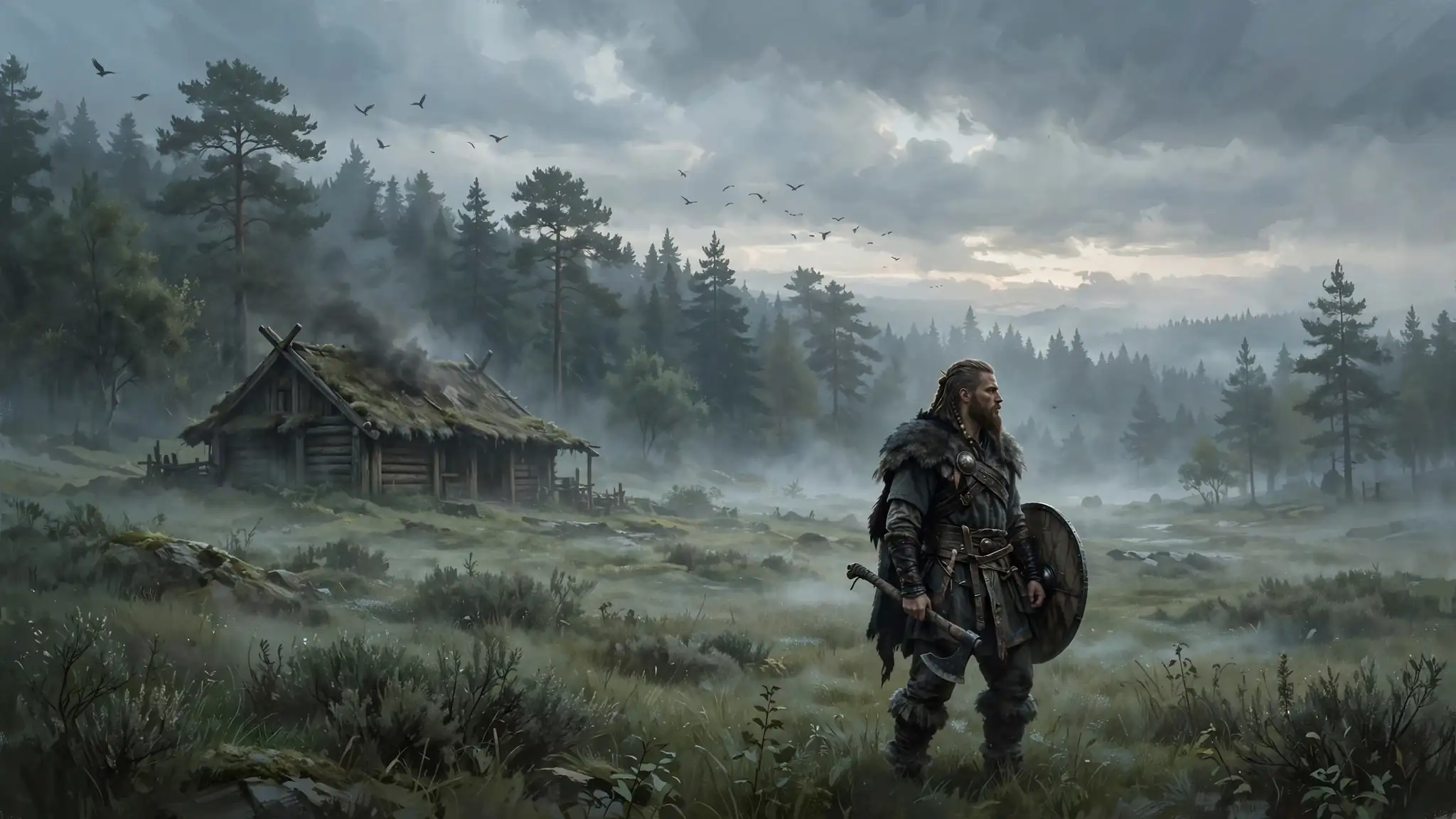
⏱️ Your First 60 Minutes
- Punch trees and gather wood + stone near spawn
- Craft a stone axe and hammer
- Build a workbench under a simple lean-to roof
- Cook food at a campfire and eat for health + stamina
- Place a bed to set your spawn point before dark
You wake up under a stone circle with a raven staring at you, a torch in your hand, and absolutely no idea what you are doing. That is the correct way to start Valheim. The game does not hold your hand — it points at a giant deer god and tells you to go get him. This guide exists so your first few hours feel like an adventure instead of a series of confused deaths.
This guide is written for the 1.0 release of Valheim, which launched on 9 September 2026 after more than five years in early access. The core survival experience is unchanged — punch trees, build a hut, eat dinner, fight gods — but 1.0 is the biggest the game has ever been, and there are a few things you should know before you start. Everything below comes from the actual 1.0 game, not speculation.
What Valheim 1.0 is (and what’s new for beginners)
Valheim is a Viking survival game. You are a dead warrior dropped into a procedurally generated purgatory called Valheim, and your job is to defeat a chain of eight bosses, each one unlocking the tools you need to survive the next biome. It starts gentle in sunny Meadows and ends in the frozen Deep North. Most of your time will be spent exploring, gathering, building bases, and getting absolutely wrecked until you figure out each new area’s rules.
Version 1.0 is the finished game. The headline addition is the Deep North, the eighth and final biome — a vast frozen wasteland at the top of the map, about two and a half times the size of any previous biome, with its own enemies, dungeons, gear tier, and a final boss: Kall Fimbulbringer, a frost-giant Jotun. Beyond that, 1.0 adds 40+ new weapons across the Nord, Frostfire, and Thunderblood weapon lines, four new armour sets, a grappling hook, more than 80 new building pieces, 20+ new foods, 53 achievements, and deep-snow mechanics (in some areas the snow is so deep you need a shovel to clear it before you can build).
It also launched on PlayStation 5 and Nintendo Switch 2 with full crossplay across PC, Mac, Linux, Xbox, PS5, and Switch 2 — the first time every platform can share one world. One thing that matters for you as a new player: nothing about 1.0 changes the early game. The Meadows are the same gentle starting area they have always been. The Deep North is the very last biome you will reach, hundreds of hours away. Play it like everyone else did — one boss at a time — and the endgame will be waiting for you when you get there. The full boss order is Eikthyr, the Elder, Bonemass, Moder, Yagluth, the Queen, Fader, then Kall Fimbulbringer.
Your first 10 minutes: spawn, punch trees, gather
You spawn at a circle of standing stones called the Sacrificial Stones. A raven named Hugin will start following you around and handing out tutorial tips — read them. Interact with the stone marked Eikthyr to get his summoning location marked on your map. Then start walking. Look for a big open area near water: that is where you will build.
Your first job is gathering, and the game expects you to start with your bare hands. Punch small trees and pick up the wood that falls. You need about 4 wood, then craft a Stone Axe — it costs 4 wood and 4 stone, and it changes everything. Grab stones from the ground, and gather flint from the shallow edges of streams and ponds (those white pebbles by the water). Flint unlocks your first real weapons: the Flint Knife, Flint Spear, and Flint Axe.
While you walk, pick up everything. Raspberries, mushrooms, dandelions — all free food or useful later. Kill deer when you can (sneak up on them with CTRL held down); deer meat is your best early food and deer hides become your first armour. Greydwarves drop resin, which keeps your torches and fires burning. Don’t be precious about anything yet. Just fill your pockets and learn the rhythm: left-click swings, and holding shift while clicking does the heavy attack.
The workbench and your first tools
The Workbench is the most important object in your early game, because nothing can be crafted or repaired without one nearby. It costs 10 wood. Here is the catch beginners always trip on: a workbench only functions under a roof. Drop it on the ground in the open and it sits there useless. So your actual first build is always a tiny hut — four walls, a roof, and the workbench inside. Do not overthink it. Ugly is fine. You can rebuild it nicer on day three.
Once the workbench is covered, craft in this order. Stone Axe first (4 wood, 4 stone) for chopping trees faster. Then the Hoe (5 wood, 2 stone) — this is the tool nobody respects and everybody needs, because it lets you flatten ground, which makes building infinitely easier. Then a weapon: the Flint Spear is excellent early because you can throw it, but the Flint Knife is cheap and fast. Add a Wooden Shield as soon as you have a torch’s worth of spare wood — blocking is your single most powerful defensive tool in the early game, and it costs almost nothing.
One more thing about the workbench: repairs are free. Every tool and weapon can be repaired at a workbench with no materials cost. So upgrade your Stone Axe to the Flint Axe when you have flint, then stop babying your gear. Break things, fix them, keep moving.
Shelter, campfire, bed: set your spawn point
Night is coming, and night one is when the game gets real. Before dark, you need three things inside or next to your hut: a campfire (5 stone, 2 wood), a bed, and a roof over the bed. Build the fire on bare dirt — it will not light on a wooden floor, and yes, you will try. Then sleep.
The bed is more than a skip-the-night button. When you sleep in a bed, your spawn point moves there. That means when you die — and you will die — you wake up at home instead of naked at the stone circle. Sleeping also fast-forwards to morning, which skips the dangerous dark hours entirely. Early on, the best strategy in the game is simply: do your gathering in the day, go home and sleep at night.
Keep your campfire lit at home. Standing near a fire while sheltered gives you the Resting effect, and resting for about 20 seconds converts into the Rested buff — more on that below. It is free, it stacks with everything, and there is no reason to ever leave the house without it. Greydwarves hate fire, by the way. A ring of campfires around your base is cheap perimeter defense in the early game.
Food and the rested bonus: the two systems beginners ignore
Valheim does not have hunger. Your stomach has three slots, and food gives you temporary boosts to maximum health and stamina. Your base health is only 25 — pathetic — but three good foods can push you past 100. Every food has a red fork (health-focused), yellow fork (stamina-focused), white fork (balanced), or blue fork (eitr, which is mana for magic later). Early on, eat one of each category you have: cooked deer meat, cooked neck tails, and a mushroom is the classic day-one combo. Cook raw meat on a campfire — never eat it raw.
Two rules to remember. First, you cannot eat the same food twice at the same time — the game wants variety, so mix your three slots. Second, food effects wear off over time, and the icon in the bottom-left corner starts blinking when a slot can be refreshed. When a food’s buff is fully gone, the game tells you plainly that you can eat something more. Do not let yourself run around at 25 health. That is how a boar kills you and you feel embarrassed.
The Rested bonus is the other free power nobody uses enough. Rest near a fire for about 20 seconds and you get the Rested buff: +50% health regeneration, +100% stamina regeneration, +50% experience gain, and +100% eitr regen. The duration scales with your home’s Comfort level — every point of comfort adds one minute, starting from 7 minutes at base. Even a basic setup gives you around 8–12 minutes. Furniture like rugs, banners, chairs, and better beds all raise comfort, and each item type only counts once, so variety beats quantity. Before any fight — boss or otherwise — sit by your fire, get Rested, then go. It is a massive, free advantage.
Preparing for Eikthyr, the first boss
Eikthyr is the giant lightning stag you were pointed at from minute one. His summoning altar is in the Meadows, and you already marked it by interacting with his stone. To summon him, you sacrifice 2 Deer Trophies at the altar — those drop randomly from hunting deer, so hunt until you have two. Summon him only when you are ready, because once he appears, he stays, even if you die and have to run back naked.
Your gear checklist: a full set of Leather Armour (crafted from deer hides — the full set takes 22 hides plus bone fragments, which you can find in Meadows stone graves and burial chambers), a Flint Spear or Flint Knife, a Wooden Shield, and a Crude Bow with a stack of arrows. Bring three foods and eat before the fight. Get the Rested buff. The bow is your best friend here — Eikthyr is fast up close and hits hard.
The fight itself: Eikthyr has three attacks. He fires a lightning bolt in a straight line (sidestep it, then close in), he slams down an area-of-effect lightning burst (back off until it dissipates, then go in), and he swipes with his antlers up close (block with your shield or dodge sideways). Do not stand in front of him. Attack his flanks, dodge the lightning, and be patient — he has a lot of health. When he falls, you get Hard Antlers (which unlock the Antler Pickaxe, your first mining tool) and the Eikthyr Trophy. Mount the trophy at the Sacrificial Stones to unlock your first Forsaken Power: a stamina and sprint boost. That power is on a cooldown, so save it for when it counts.
Your first 10 days: a plan
Day one is everything above: gather, build a hut with a workbench, make tools, light a fire, build a bed, sleep. Days two through four, upgrade to flint gear, hunt deer aggressively for hides and trophies, and improve your base — a cooking station over the fire, a bigger roof, maybe a fence. Explore the Meadows fully. Find the Black Forest edge, but do not live in it yet.
By days five to seven you should be wearing full leather armour, eating three cooked foods, sleeping Rested every night, and comfortable with the bow. Now venture into the Black Forest for bone fragments, copper, and tin — copper and tin together make bronze, your first metal tier. Trolls live there, and trolls will one-shot you in leather, so respect them. Sneak, avoid, and mine the burial chambers.
Days eight to ten: you have bronze on the horizon, Eikthyr’s location marked, and two deer trophies in your pocket. That is when you go fight the stag. After Eikthyr, the Antler Pickaxe lets you mine copper and tin properly, the Elder (second boss, in the Black Forest) becomes your next target, and the real game begins. Do not rush to day ten — Valheim rewards the prepared and buries the hasty.
7 mistakes beginners make
1. Building the workbench in the open. It only works under a roof. Every new player does this, spends five minutes confused, and then builds the hut anyway. Build the hut first.
2. Sailing too far too early. The raft is slow, the ocean is huge, and the serpent does not care that you are new. Stay coastal until you have a proper boat and the gear to survive a storm.
3. Fighting trolls in the first week. Trolls wander the Black Forest and will flatten you in one or two hits while you are in leather. If you see one, leave. There is no shame in it.
4. Ignoring food. Running around at 25 base health is how you die to a boar on day two. Eat three foods, every time, before leaving home. It takes ten seconds.
5. Carrying everything, dying with everything. When you die, you drop everything you were carrying in a tombstone at your corpse. Leave your good gear at home for risky trips, and always carry portal materials (10 greydwarf eyes, 20 fine wood, 2 surtling cores) once you unlock portals — they turn a corpse run into a two-minute errand.
6. Skipping the bow. Melee-only players hit a wall against flying enemies, the Elder, and half the boss fights. Craft the Crude Bow early, keep arrows stocked, and learn to aim.
7. Building a masterpiece before you understand the game. Your first base will be demolished, outgrown, or abandoned. Make it functional, not beautiful — wood walls, a roof, a workbench, a fire, a bed. The pretty longhouse comes later, once you know where you actually want to live.
Frequently asked questions
When did Valheim 1.0 release, and what’s new in it?
Valheim 1.0 launched on 9 September 2026, ending more than five years of early access. The headline addition is the Deep North — the eighth and final biome, a huge frozen region with deep snow, slippery ice, new dungeons, and the final boss Kall Fimbulbringer. It also adds 40+ new weapons, four new armour sets, a grappling hook, 20+ new foods, 53 achievements, and launches on PS5 and Nintendo Switch 2 with full crossplay across every platform.
How do I set my spawn point in Valheim?
Sleep in a bed. When you sleep, your spawn point moves to that bed, so you respawn at your base instead of the starting stones when you die. Sleeping also skips to morning. The bed needs a roof over it and a nearby workbench to be placed.
What do I need to beat Eikthyr, the first boss?
Sacrifice 2 Deer Trophies at his altar in the Meadows to summon him. Bring a full set of Leather Armour (22 deer hides), a Flint Spear or Knife, a Wooden Shield, a Crude Bow with plenty of arrows, three foods eaten beforehand, and the Rested buff. Dodge his lightning bolt sideways, back off from his lightning burst, and attack his flanks. He drops Hard Antlers for the Antler Pickaxe and a trophy that unlocks your first Forsaken Power.
How does food work in Valheim 1.0?
Your stomach has three slots. Eating food temporarily raises your maximum health and stamina — from a base of 25 health up to 100+ with three good foods. You can’t eat the same food twice at once, so mix categories: red fork foods boost health, yellow fork foods boost stamina, white fork foods are balanced. Food effects wear off over time, and the icon blinks when you can refresh a slot. Cook all meat on a campfire first.
Should I start a new world for Valheim 1.0?
If you are a brand-new player, just create a fresh world — you will see everything as intended. If you are returning with an old world, it still works, but the new Deep North biome content only generates in areas you have never explored. If you have already mapped most of the north, Iron Gate recommends starting a new world to get the full 1.0 experience.
That is the whole game in miniature: eat, rest, build, and respect the lightning deer. The Deep North is waiting at the end of the road — but the road starts in the Meadows, with a Stone Axe and a bed. Go get your antlers, Viking.
2 thoughts on “Valheim 1.0 Beginner Guide 2026: Your First 10 Days”